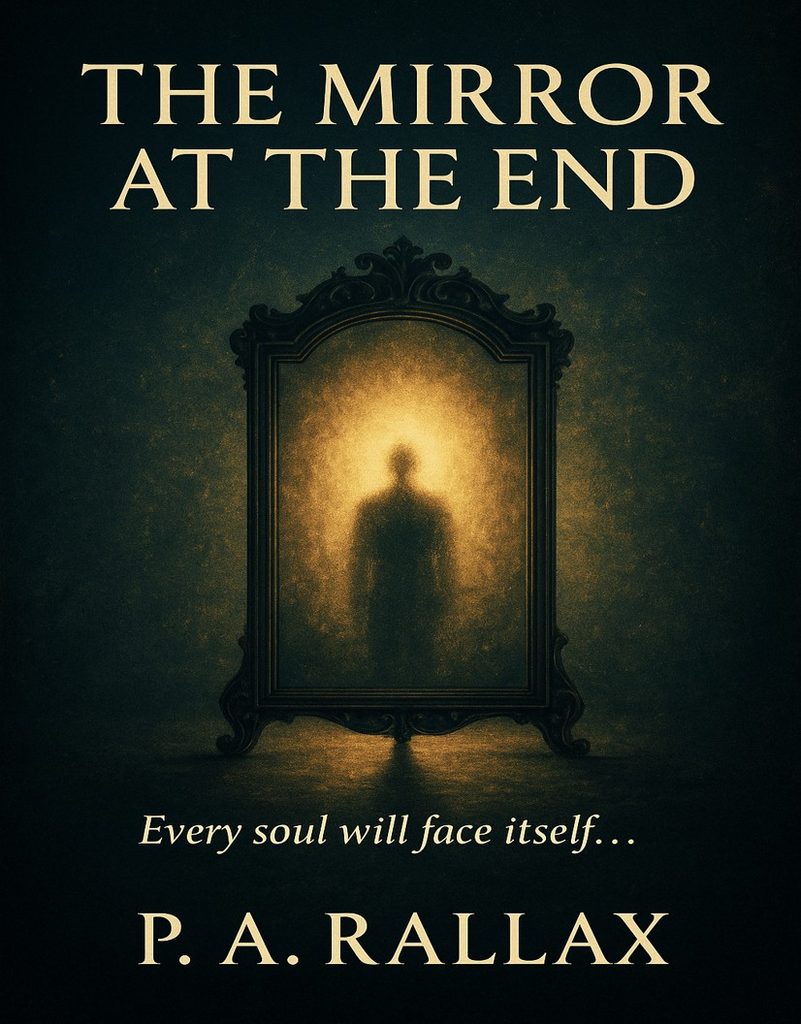
THE MIRROR AT THE END
Every soul will face itself…
Introduction for The Mirror at the End
Every soul will face itself.
After the death of his grandfather, David Stein enters an attic that has remained untouched for decades. Hidden among the remnants of a life marked by war and survival, he discovers a linen-bound manuscript dated May 1, 1945. Written in German and accompanied by a cryptic instruction from his grandfather, the document makes an impossible claim: its author is writing from beyond death.
What begins as a mystery becomes something far more unsettling. The manuscript describes a realm beyond ordinary time, where a soul is guided by a mysterious presence known as the Archivist. There is no courtroom, no sentence, and no divine accusation. Instead, the soul is required to see—to experience the consequences of a life not from the safety of memory, but through the consciousness of those whose lives it touched.
One by one, the barriers of identity begin to fall away. A child finds refuge in music. A soldier confronts the cost of obedience. A mother carries an unbearable loss. A stranger performs an unnoticed act of mercy. Another man discovers that silence can become its own form of participation. The soul is not allowed to explain, justify, or look away. As the Archivist tells it, the purpose is not punishment: “We do not punish. We reveal.”
As David continues reading, the manuscript forces him to confront questions that extend far beyond the identity of its mysterious author. What happens when every rationalization disappears? Can a human being ever escape the consequences of what was done—or left undone? And if there is a mirror waiting at the end of life, what would any of us see reflected there?
The Mirror at the End is a metaphysical novel about memory, moral consequence, complicity, empathy, and the possibility that the final reckoning of a life may come not from an external judge, but from seeing oneself completely.
Companion Soundtrack
A Novel in Words. A Journey in Sound.
Museca created an original soundtrack as a companion to The Mirror at the End. The music follows the emotional architecture of the novel—from the first fracture in a carefully constructed identity, through childhood memories, moral confrontation, grief, compassion, and ultimately the mirror itself.
The soundtrack can be experienced independently or alongside the book. Together, the novel and music approach the same questions from two different directions: one through narrative, the other through sound.
Listen to the Original Soundtrack →
The Mirror at the End — Original Soundtrack by Museca
Read the Book
The Mirror at the End is available as a complete PDF.
Download The Mirror at the End — PDF ↓
Content Note: This novella contains fictionalized depictions of war, persecution, the Holocaust, violence, and the deaths of children. It approaches these subjects through the themes of memory, witnessing, moral consequence, and spiritual accountability.