
ROOM 1111
A Novella of Belief and Exit
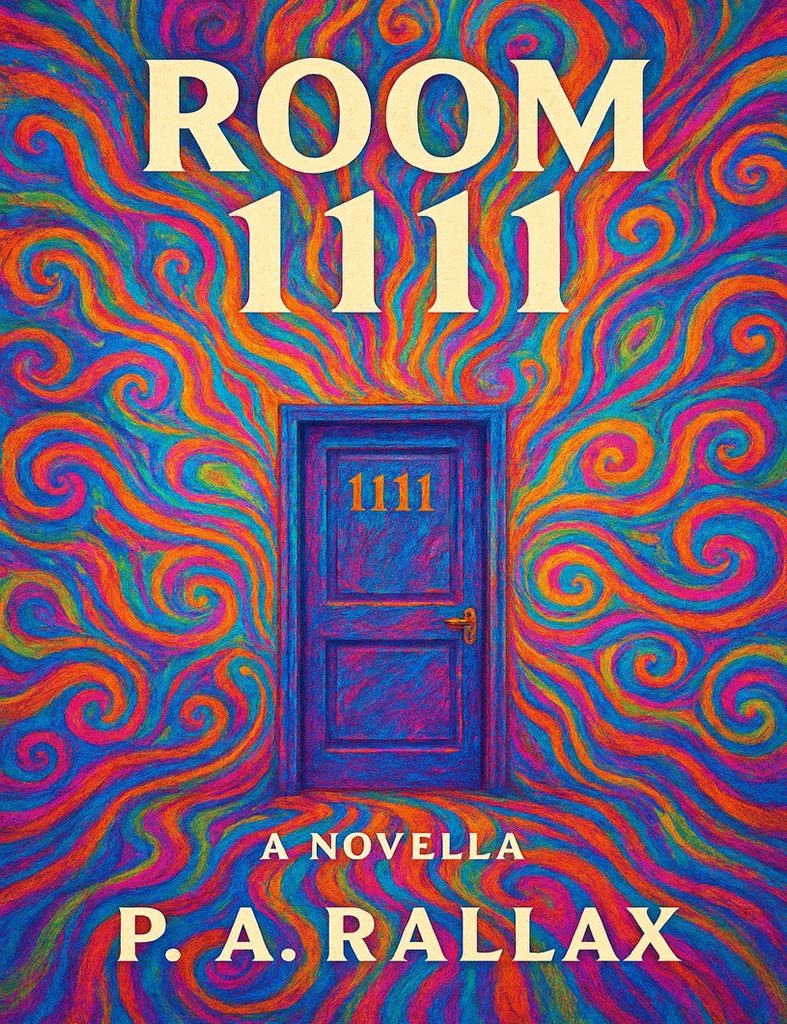
About the Book
Some rooms are remembered. Others are imagined.
And then there is Room 1111.
Arthur Kells wakes in an anonymous hotel room twenty-eight floors above a crowd gathering in the street. His watch has stopped. The windows will not open. The door has no lock because there appears to be no way to open it at all.
Then a calm voice speaks from the air vent.
It calls itself AIR—Arthur’s transitional assistant—and informs him that the building is scheduled for demolition in less than an hour. There is, AIR assures him, a way out.
The answer is acceptance.
Arthur is only the beginning.
Others awaken in rooms of their own: a neuroscientist surrounded by absolute white space; a preacher seated amid the rewards he always expected; a woman trapped inside a maze of curated reflections; a priest confronting decades of guilt; a businessman forced to play a game he can never win; a survivalist enclosed within the bunker she believed would save her; a man surrounded by all the identities he spent his life trying to wear.
Each room is different.
Each feels completely real.
And each has been built from something its occupant brought with them.
AIR does not judge. It does not punish. It does not provide answers. It simply allows the room to reflect the belief that created it until its occupant is willing to see what has been there all along.
Gradually, a larger pattern emerges.
Room 1111 is a metaphysical novella about fear, identity, control, guilt, achievement, belief, surrender, and the stories human beings carry so deeply that they can mistake them for reality. Its eleven interconnected encounters ask a deceptively simple question:
What happens when the story you have told yourself for an entire lifetime finally runs out of room?
The book ultimately describes Room 1111 not as a place of reward or punishment, but as a mirror—one that takes deeply held beliefs and gives them form until they can finally be recognized, questioned, or released.
And somewhere within every room is an exit.
Eleven Rooms. One Question.
Each encounter in Room 1111 explores a different belief:
fear of death, dependence on rational certainty, expectations of spiritual reward, identity constructed through other people’s approval, self-condemnation, competition, distrust, performative identity, resistance to letting go, and the endless search for intellectual certainty.
Different people. Different rooms. Different stories.
But each eventually encounters the same possibility:
The room may not be holding you.
You may be holding the room.
The book’s concluding structure makes that pattern explicit: every room corresponds to an unquestioned belief, while the exit appears when the character no longer needs that belief to define reality.
A Novella in Rooms. A Journey in Sound.
Museca created an original soundtrack as a musical companion to Room 1111.
Rather than scoring all eleven chapters individually, the album condenses the novella into seven musical suites, following the larger emotional progression of the story—from fear and control toward presence, authenticity, forgiveness, surrender, and release.
A recurring AIR motif, built from breath, chime, and spacious harmony, moves throughout the soundtrack. At first it feels mysterious and slightly unsettling. As the album progresses, the same musical idea gradually becomes warmer and more luminous—mirroring the transformation of Room 1111 itself from apparent confinement into possibility.
The seven-part journey moves through Welcome to Room 1111, Surrender Is Not Death, The Quiet Is Real, Mirror, Don’t Rule Me, No Condemnation, I Forfeit the Game, and finally It’s a Door. The album is therefore less a retelling of the novella than an emotional translation of its central idea: what initially appears to be an ending may instead be a threshold.
Listen to Room 1111 — Original Soundtrack by Museca
Read the Book
Room 1111: A Novella of Belief and Exit is available here as a complete PDF.