The Girl Who Rewrote the Rules
For readers ages 9+
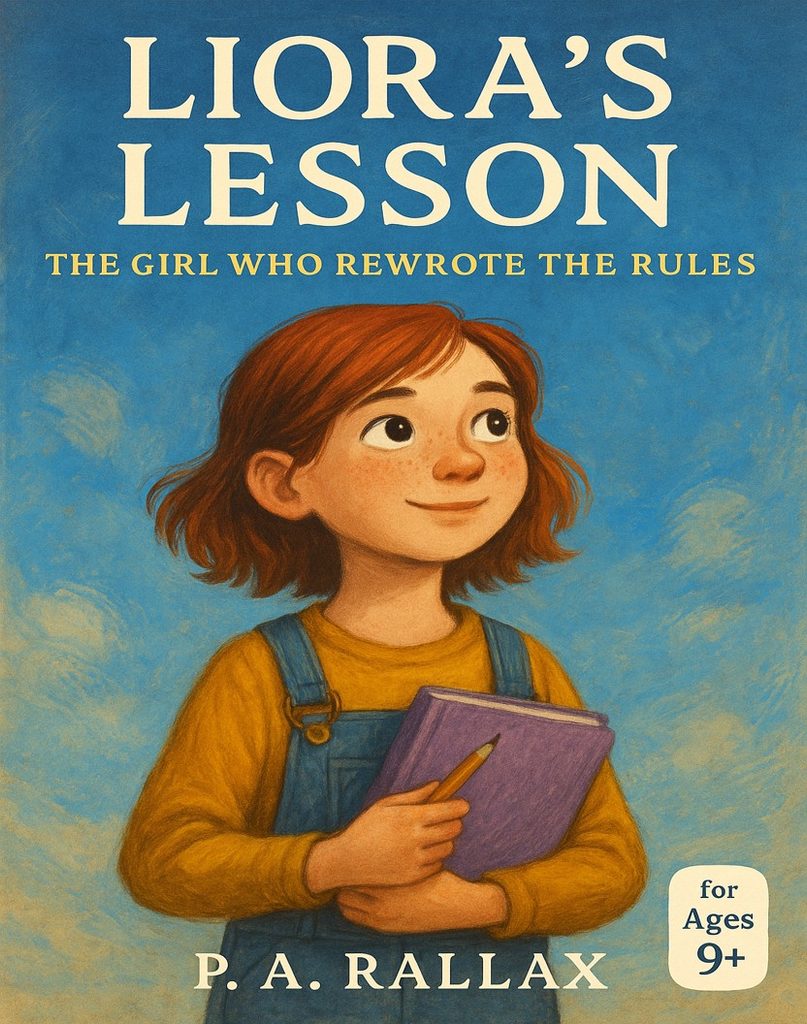
About the Book
Liora Martin is the new girl in Room 6B.
She is quiet, observant, kind—and she has an unusual habit of asking questions that everyone else has stopped asking.
When her teacher asks for the capital of Nebraska, Liora knows the answer. But instead of raising her hand, she wonders why students are expected to remember things without understanding why they matter. It is not rebellion. It is something gentler—and, in its own way, far more disruptive.
Soon Liora’s questions begin spreading beyond one classroom.
She notices the boy everyone else avoids and wonders whether he is angry—or simply tired of being misunderstood. She asks whether mathematics might measure more than numbers. She introduces the idea of a daily Soul Period, when students stop talking, stop performing, and simply sit quietly long enough to remember that they are more than their grades. She transforms detention by asking what might happen if someone tried to understand difficult behavior before punishing it.
Little by little, the school begins to change.
Teachers reconsider what makes something worth learning. Students begin giving answers that are emotionally true even when they do not fit neatly onto an answer key. A purple notebook filled not with assignments but with questions becomes a collection of Remember Books, passed from child to child. And the adults who initially worry that Liora is disrupting the system gradually begin asking a much harder question:
What is school actually for?
Liora’s Lesson is a warm, humorous, and quietly philosophical story about curiosity, education, belonging, compassion, creativity, and the courage to question rules without losing kindness.
It does not argue that facts do not matter or that structure has no place. Instead, it asks what may be missing when education measures what a child remembers but not what a child feels, notices, imagines, or becomes.
At the center of the book is a deceptively simple idea: perhaps children do not always need adults to fill them with more information. Sometimes they need adults willing to listen to what they already know.
As Liora eventually tells a room full of parents:
“We’re not trying to undo what you’ve taught us. We’re just adding back what the world asked us to forget.”
For Young Readers—and the Adults Who Teach Them
Although Liora’s Lesson is written for younger readers, it is equally a story for parents, teachers, and anyone who has wondered whether education can make more room for curiosity, emotional awareness, stillness, creativity, and wonder.
The author’s note describes the story as imagining what might happen if even one child began living according to a different understanding of learning—not to overturn the world, but to remind it of something it may have forgotten.
A Story in Words. A Lesson in Sound.
Museca created an original soundtrack as a musical companion to Liora’s Lesson.
The album follows the same gentle transformation as the story: rigid routines gradually give way to curiosity, stillness, imagination, compassion, and belonging. Its musical language deliberately draws on childhood wonder—celesta, harp, flute, clarinet, piano, soft strings, and a children’s choir—with very little heavy percussion.
The soundtrack begins with an almost clockwork quality representing inherited rules and automatic answers. As Liora’s influence spreads, that musical world softens into warmer chamber textures, storybook colors, and moments of luminous stillness. The children’s choir becomes particularly important in Soul Period, where wordless voices represent a classroom discovering what it feels like simply to be quiet together.
Several of the book’s central moments receive their own musical counterparts, including That’s What Everyone Says, Max’s Galaxy, Soul Period, The Grown-Ups Listen, The Remember Book, and the closing Notebook on the Shelf.
Listen to Liora’s Lesson — Original Soundtrack by Museca →
Read the Book
Liora’s Lesson: The Girl Who Rewrote the Rules is available here as a complete PDF.
Download Liora’s Lesson — PDF ↓